



Overview

From “The Experiment to Return the Piano to Nature”

Ryuichi Sakamoto and STEINWAY & SONS Z114
(Chippendale)
In March 2023, musician and artist Ryuichi Sakamoto passed away.
In 2014, he began an “experiment to return the piano to nature,” placing an old piano he had found in Hawaii in the garden of his New York home. Exposed to rain, wind, and time, the instrument—once a product of human civilization—was left to gradually decay as he quietly observed its subtle transformations.
On March 11, 2026, fifteen years after the Great East Japan Earthquake, Seitaro Yamazaki will carry forward Sakamoto’s spirit of “social sculpture” in Hirono Town, Fukushima Prefecture.
The second piano in this experiment is a 1960s STEINWAY & SONS Model Z114 (Chippendale), the instrument used in the recording of Sakamoto’s final album, 12.
This project questions the coexistence of nature and civilization. Through its public presentation, it seeks to share Sakamoto’s intellectual legacy while opening space for reflection on Fukushima’s reconstruction, humanity’s relationship with nature, and the meaning of time.
Operated by: Seitaro Design Inc.; Sakamoto Library Association
(sakamotocommon)
With the cooperation of: Hirono Town, Fukushima Prefecture


From “The Experiment to Return the Piano to Nature”

Reflections on Hirono Town
Hirono Town, Fukushima Prefecture, was fully evacuated following the 2011 Great East Japan Earthquake and Fukushima Daiichi Nuclear accident. Today, the town is entering a new phase of recovery, focusing on settlement, education, sports, and town-building that connects to the future through art—a place where the richness of nature and the weight of post-disaster time coexist.
As of 2026, over 90% of residents have returned, yet healing emotional wounds and shaping a shared vision for the community remain ongoing challenges.
The nuclear accident’s impact extends beyond space to time: cesium-137, with a half-life of about 30 years, continues to affect social life and decision-making. While some areas have been decontaminated, forests and spaces beyond daily living zones remain a complex symbol of recovery.
Disaster remnants and radiation markers document the immediate aftermath, but few tools confront the “long duration” of nuclear impact. Exposed gradually to wind and rain, the piano in Hirono visualizes this irreversible passage of time, offering a quiet reflection on the intersection of human activity and nature.

From “The Experiment to Return the Piano to Nature”
Profile
sakamotocommon

“Sakamotocommon” is an initiative dedicated to sharing what Ryuichi Sakamoto left behind. It seeks to transform his intellectual and material legacy into a cultural commons—open to be activated and reinterpreted by future creators.
Sakamoto often said that he found the process more interesting than the finished work. For that reason, what remains should not be confined to storage in museums or archives. Even after his passing, his legacy should continue to be cultivated, renewed, and set in motion. The process does not end.
Sakamotocommon is an attempt to open not only his works, but the ongoing process itself, to everyone.
Ryuichi Sakamoto
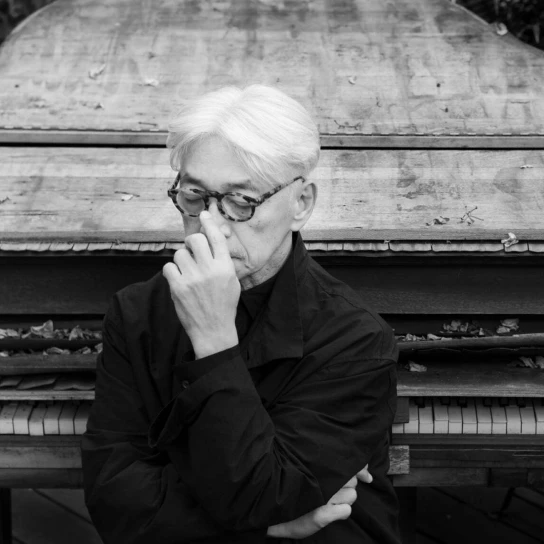
Photo by Neo Sora ©2020 KAB Inc.
Born in Tokyo in 1952, Ryuichi Sakamoto earned a master’s degree from the Tokyo University of the Arts. He made his solo debut in 1978 with Thousand Knives and co-founded Yellow Magic Orchestra (YMO) the same year, helping shape the global development of electronic music.
After YMO disbanded in 1983, he continued to pursue innovative sound through albums such as Ongaku Zukan, BEAUTY, async, and 12, earning international acclaim for his boundary-defying work.
In film, he won the BAFTA Award for Merry Christmas, Mr. Lawrence, and received the Academy Award, Golden Globe Award, and Grammy Award for The Last Emperor, among numerous other honors.
His practice extended beyond music into stage and large-scale installation works including LIFE and TIME, as well as major exhibitions at piknic (Seoul, 2018), M WOODS (Beijing, 2021; Chengdu, 2023–2024), and the Museum of Contemporary Art Tokyo (2024–2025).
Committed to environmental and peace initiatives, he founded the forest conservation organization more trees and established the Tohoku Youth Orchestra to support young musicians in disaster-affected regions.
Ryuichi Sakamoto passed away on March 28, 2023.
Seitaro Yamazaki
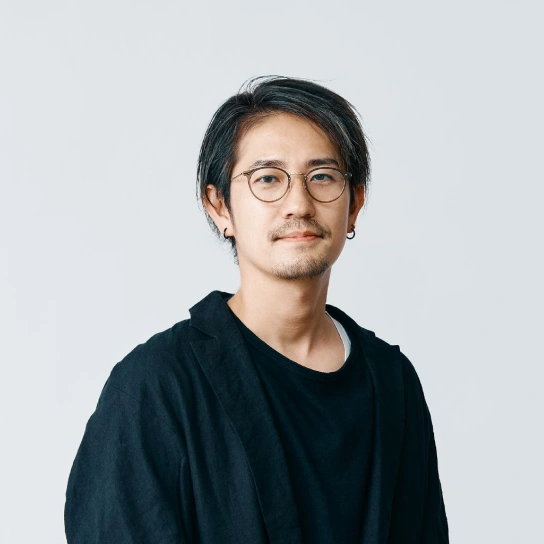
Seitaro Yamazaki is the CEO of Seitaro Design Inc., and a creative director and artist. Guided by his belief that “society can be changed through design,” he has led numerous projects in collaboration with government ministries and corporations. Major projects include the Tokyo 2020 Olympic and Paralympic Awards Ceremonies, JR West, Former Nara Prison, and Daikanyama ASO.
As a contemporary artist, he draws on Japanese aesthetics such as yohaku (conceptual space) and impermanence, exploring the value of silence, residue, and ambiguity in modern society. He has held large-scale solo exhibitions in Tokyo, Shanghai, Berlin, and Washington, D.C., and participated internationally, including at the 2025 Larkana Biennale and SXSW.
Following his brand design work for Hatagoin Fukushima Hirono, he became director of the “Marginal Art Fair Fukushima Hirono,” engaging in initiatives that connect cultural practice with regional recovery and revitalization.
He also appears as a cultural commentator on TBS’s Joho 7days News Caster and Nippon TV’s Bankisha! and Shuichi, and is the author of Yohaku Shiko (The Art of Emptiness) (Nikkei BP).